Monday, October 8, 2018

Fragment of Horror 2

Since it's Halloween, all the theme parks and Halloween inspired locals from all over the U.S. and the world will be opening up. Knott's Scary Farm, Halloween Horror Nights, the Bates Motel and Haunted Hayride in Pennsylvania (Running 28 years! Congrats guys!) Terror on the Fox in Winsconsin, Thrillvania in Texas, and others opening their doors and getting ready for a new season of terror and fright. But the most common of all these places is that at least they all have a big haunted house. And the idea, since the early Victorian Literature era, has influenced pop and high culture for so long.


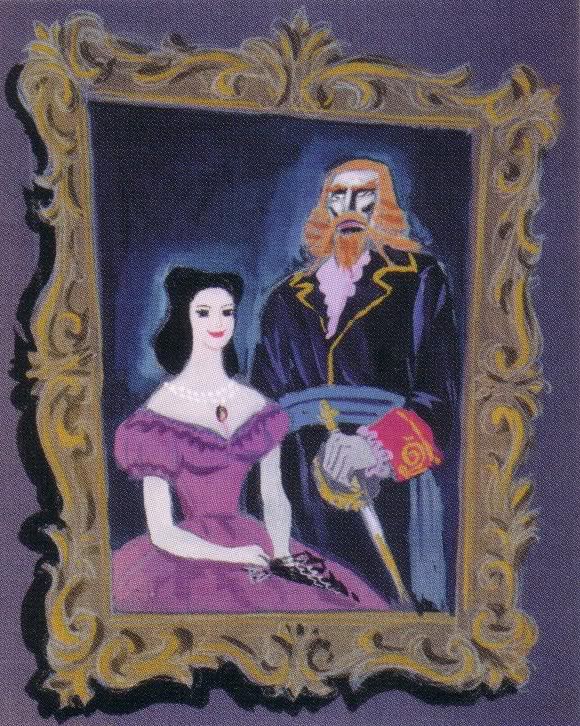
Image result for haunted mansion concept sketch
(Concept Art for a famous attraction. Read further for the reveal of my second fragment of Horror)


Like the concept that we in this picture for the haunted house we'll see in this article, many stories either have ghosts or Gothic drama that happens and that gives a home/manor, a haunted house atmosphere. You have manor houses like Northanger Abbey, Manderlay from Rebecca, Shirley Jackson's Hill House (Soon to be a Netflix series and the trailer looks great. I hope the re-imagining of the story is a success.), Collinswood from the series (NOT THE MOVIE!) Dark Shadows, and who could forget The Overlook Hotel and Rose Red from Stephen King. But my second fragment of horror was a collaborative effect. One so famous that the concepts and ideas had so much that they had to find ways to remake the ride from a walk through, to a museum holding weird and creepy objects, a home to evil and treasonous people from history, and had a Bluebeard type wife killer. But it all eventually came to a simple philosophy about the ride "We'll take care and clean up the Outside, and the ghosts can take care of the Inside." This was said by Walter Elias Disney and the concept art you're looking at is ...


Image result for Disney's Haunted Mansion
(The Haunted Mansion in all her Southern Gothic Antebellum Glory)

The Haunted Mansion, my second Fragment of Horror.


You're probably wondering, why the hell is this on here? It's not a scary ride. Well it scared me when I was young and I took thinks literal but don't insult me for it! But this article is more about the concepts and the impacting legacy of one of the most rumor and fan theory laden rides and sadly a dying part of a great theme park. A true and somber Gothic tale in it's own right. But most don't know that the concepts for this Haunted Mansion went as far back as the first days of Disneyland. In fact, Walt Disney himself wanted such a house in the most oddest of places.


In the early days of acquiring some orange groves, Anaheim would be forever changed by the vision of Walt Disney himself, his 9 Old Men animators and newly solidified cast of artists and designers who though, never made theme park attractions before, would now begin with innovating technology and ride ideas to make a theme park in Walt's vision. From a simple train ride though his Burbank back lot to grow ever bigger into the theme park we know today, Disney's original concept pitch for the mansion would be to put it, in all places, Main Street U.S.A.


The concept art you saw earlier was supposed to be in Main Street U.S.A. with the house on a hill, (All the Haunted Houses are on Hills, what is up with that?) And so you got a Haunted House near Main Street scaring the kids before they got into the park in contrast to the happy and nostalgic view of Main Street with late 19th-early 20th century America. But the main issue was how would this ride be sold to the audiences? Enter one Disney's greatest concept rivalries, Claude Coats, animator and set designer, who wanted a scary haunted mansion which would be attributed to how Disneyland would promote innovation and design in creating a new standard for theme parks, and Marc Davis, legendary animator and one of the 9 old men, who wanted a silly and family friendly ride since Disneyland's main attraction was to be sold as an experience for all to come.

Image result for claude coats
(And our first two major players are here. Claude Coats, Disney's Gentle Giant)
Image result for marc davis
(And Marc Davis, working on art for Pirates of the Carribean)
This rivalry happened for quite a long time. Two major and important members of the Disney staff, influencing the tone of what would be a beloved E-Ticket Experience. But in the end, we got a combo of both but this doesn't end the main problems of this ride. After all, it did take 16 years to get it all together. And 3 were without the main man at their side. But with a concept finally revealed, now it was the time to get the settings and illusions ready for the mansion. And with that, we have two other guests to introduce but here's a picture of my favorite illusion that stumped me for a while thinking ghosts did exist.


Image result for haunted mansion pictures
(The Ballroom Scene, depicting the famous stage and ghost illusion The Pepper's Ghost Trick)
Another reason why the Haunted Mansion works so well is because the Illusions are surprisingly effective and timeless. Though the illusions were developed by 19th century phantasmagoria thanks to magicians and illusionists who were popular at the time. Pepper's Ghost, the effect used in the ballroom. was commonly used in theatrical productions of A Christmas Carol, Macbeth and Hamlet, and other plays that feature ghosts. (If you wish to know more about Pepper's Ghost, click this link. It features a talk with Rolland (Rolly) Crump, one of the two illusionists and designers of the Mansion.) The Endless Hallway is another such illusion of the 19th century. (A Mirror being used and the lighting and darkness to make it appear as endless.) But with 20th and 21st century technology, we have the animatronics and the Holograms (some even describe holograms as perfected Pepper's Ghosts because they are inspired by the same technological idea but have more clarity for realism or whispiness for ethereal-ism.) that are made to look real towards us. It combines so well with the dark lighting to make the illusions realistic to make the haunting real towards us.


Image result for yale gracey
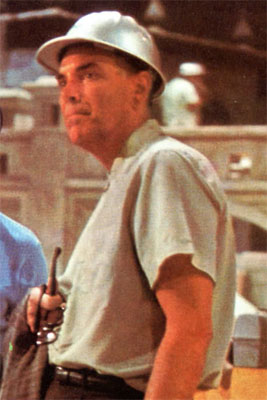
(Yale Gracey attending to the Hatbox Ghost)


Image result for rolly crump
(Rolly Crump taking a Tiki Room Tiki out of Disneyland)
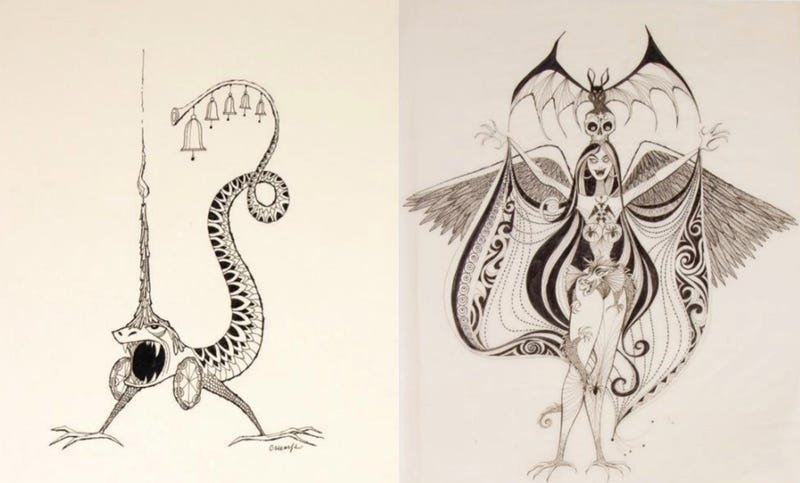
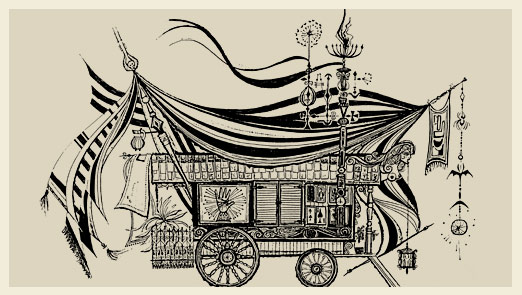
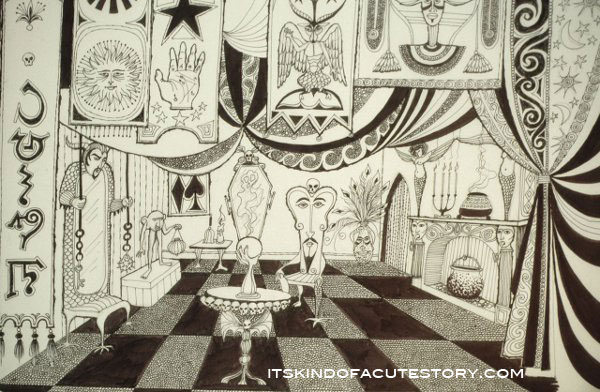
All of the original Illusions came from the two guys who experimented with it, (Yale Gracey (who many attribute to being the surname of the owners of the mansion due to the Gravestone Tribue) and Rolly Crump (designer and Disney Legend)) And Rolly helped design some of the concepts for what would be included in the Mansion, The Museum of the Weird and it was as weird and scary for it kept Walt Disney awake and in his clothes the next day after he witness the designs.

Image result for rolly crump museum of the weird


Related image


Related image


Image result for rolly crump museum of the weird
(A Candle-holder Lizard and a Vampiress Statue)
Image result for rolly crump museum of the weird
(A Gypsy Caravan: A possible influence for Madame Leota)


Image result for museum of the weird disney chair
(The Fortune Teller's Room with a Grandfather Chair. One would be in the Haunted Mansion in Disney World.)

Spooky isn't it! You Couldn't possibly imagine that people would accept this stuff in Disneyland. In fact, showing you this is actually part of all the concepts of the Haunted Mansion. You had the Museum of the Weird but some of the few mentioned usually focused upon Captain Gore. And God it was a lot bloodier than imagined. He was a Pirate who would tie into the Pirates of the Caribbean ride as a bloodthirsty pirate whose wife, Priscilla, learned of his pirating ways and would be silenced forever. The WDW tombstone tributes has a slight reference to this Bluebeard style evil with having a mausoleum an actual  Capt. Bluebeard have 7 wives who would die one after another except his last wife who would kill him.


Image result for Captain Gore
(Concept Art from Ken Anderson of Gore and Priscilla)
But now for the rumors and theories. One of my favorites is why it took so long for it to come together. People actually thought it was so scary one person had a heart attack and that the Disney animators did their job too well. Some have also claimed in the trial run of the ride, someone tried walking out of bounds and fell into a snake pit and got nearly poisoned to their death. (I Learned about this one recently!) Another too scary theory goes into one of my favorite characters of the ride, the renewed variation of The Hatbox Ghost! Some people have wondered whether it was an illusion or just a Disney Secret that they had experimented with gone wrong and was too scary. It was seen in media of the Mansion but never made an appearance. It turns out it was there but it was removed because the head removal and reappearance trick didn't work out too well in the dark.


Image result for haunted mansion disneyland hanging
(Because nothing Screams Walt Disney and The Happiest Place on Earth like Suicide, Murder, and over morbid Death)

And now for the theories. One popular theory claims that you actually die in the Haunted Mansion. When you first enter through the doors of the mansion, you see simple tricks of the light and optical illusions, nothing too concrete. But one you finish your seance with the Madame, you are brought to the Ballroom to see the ghosts who vanish and reappear before you. After the Bride scares you, you fall down to your death from the attic and the reason the Caretaker is so scared is because he sees new ghosts to join the fray! And the Graveyard swinging wake opens ups to welcome you as newly made members and residents of The Haunted Mansion. Another is that people actually believe the mansion is actually haunted with real ghosts. The mansion is a popular resting place for beloved one's ashes and are usually distributed around the ride illegally and some have claimed they see ghosts that weren't audio animatronics. One lady spread her son's ashes saying this ride was his favorite and she would love for him to officially rest in peace here. (I mean The Haunted Mansion was advertised as a Retirement home for Ghosts.)


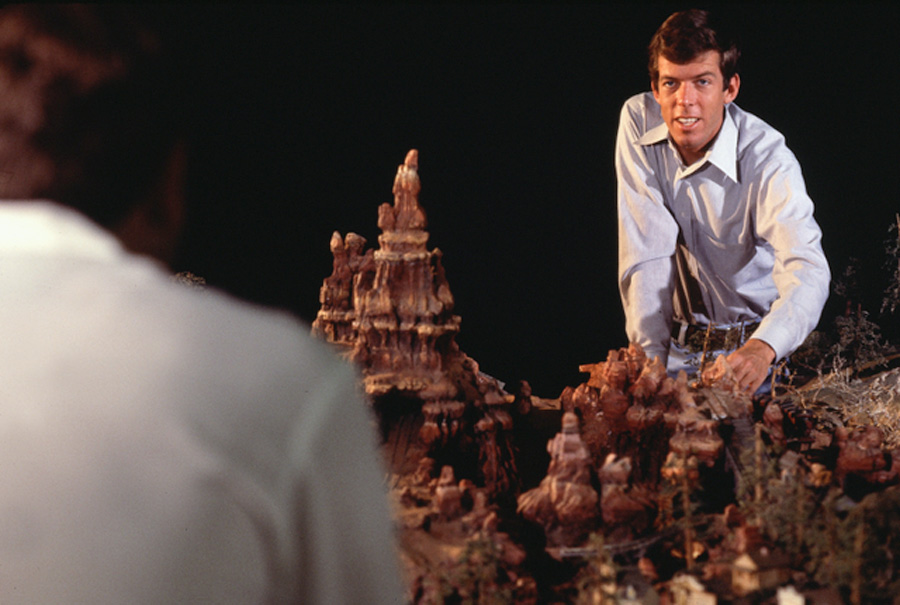
But yes, it's a lot to take in with everyone involved and it was a primarily collaborative effort. But in hind site, it references and is a sad reminder of what now happened to Disneyland. For this ride was one of the last remaining original Rides that would be in Disneyland. Think about it, most of the rides are all based on Disney properties. It's not a bad thing but it reflects a creative drive now gone that has to be molded to the style and appearance of that attractions property. Tom Morris (another Imagineer who retired in 2016)  confesses in this article some days back that "Walt allowed all of these people to show their own style. It wasn't a big corporate guidebook or style guide. Walt allowed there to be a Marc Davis style, a Claude Coats style, a Mary Blair style and Rolly — Rolly is definitely one of the Disneyland styles." Disneyland was the allowing of multiple artistic and aesthetic styles blended beautifully together and sadly, the Parks have mostly forgotten this. And this is why I noted this is a tragedy in the similar style of a Gothic Romance because The Haunted Mansion is truly the ghost of a Concept of Disneyland far forgotten. The last original Ride was Big Thunder Mountain with Tony Baxter (my favorite Imagineer) helping conceive the ride altogether.


Image result for Tony Baxter big thunder
Tony Baxter helping Shape the E-Ticket Ride, Big Thunder Mountain Railroad
It's a dying art that Tony might be one of the last Imagineers to have his own style to the parks. In fact he himself shaped the European Village aesthetic most of us grew up with and don't even realize. So let's take a look at this Haunted Mansion with a new appreciation. A Gothic Southern Belle, like in "A Rose for Emily", reflecting days since past but instead of living in the past truly dead, let's live it up like the Ghosts and have a swinging wake of a time, with all the creative and artistic freedom to truly make wonderful things.


Related image
(A Panorama View of the mansion. And no that hearse wasn't carrying Brigham Young for his funeral.)
Thanks for reading this little gem. I would go on longer but there is so much more about this and would need a second article to reference more.  (From the Sister Mansions of Phantom Manor and Mystic Manor, to the expanded Dutch Colonial cousins that have a Library, Music Room, and in one, a room that M.C. Escher would love. And of course, the cast of voices to chill your spine and even the awful film (but it did have beautiful set designs) and also the new Ryan Gosling and Guillermo del Toro and other fun facts too. Even two different comic book series.) But enjoy the following YouTube posts and articles referenced and cite sources for this article.

Chef Mayhem's Doombuggies: A Tribute Site to the Haunted Mansion (You'll need to run adobe flash)


David Oneal's Haunted Mansion Documentary


LA Times: An early Disneyland designer won over Walt Disney with his rebel reputation. Now he laments: ‘The park is gone’


Disney's Haunted Mansion (Florida) Behind the Scenes Tour with Tony Baxter

Check Out Offhand Disney's 31 Nights of Halloween to some Haunted Mansion facts.

And for some Gothic Horror, here's the fan story Nuptial Doom: The Haunted Mansion and the Bride in the Attic. It features Kat Cressida, voice of Constance Hatchaway: The Black Widow Bride.

Wednesday, October 3, 2018

Marcos' Fragments of Horror: Fragment 1

Welcome Foolish Mortals to my Fragments of Horror. 13 articles of Halloween/Horror/Spooky topics I want to discuss with you! I see you are very intrigued by it by clicking on this article. Well, let's fall down this rabbit hole and get down to brass tacks shall we?


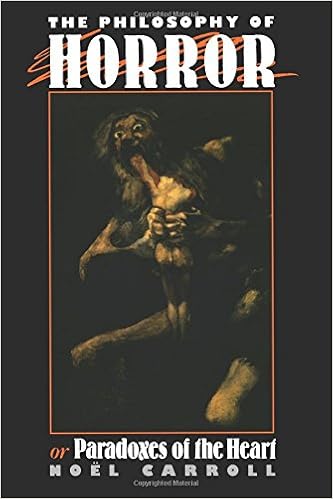
So let's discuss my first one. SO I have a question to ask before we get to the meat of our situation. What makes horror compelling? How does something so visceral ... so grotesque... so utterly unnerving get so much of our attention, in both the Halloween season and out? Well, there have been some reasons why. One is The Paradox of Horror as presented by Noel Carroll
Image result for the paradox of horror
(Cover of The Philosophy of Horror with the Grotesque Saturn Eating his Children painting)
Although I haven't had the time nor the chance to read the book, (and the copies are damn expensive) one of the main theses that Carroll promotes is the paradoxical nature of Horror. Horror is characterized in how the visceral, grotesque, and unnatural is what makes it psychologically appealing to us. So yeah, its a common sense reason but it's how it's primarily marketed. The Unnatural happenings of the Overlook Hotel persuade us to read The Shining, the grotesque murders of Hannibal Lecter and Jame Gumb (Buffalo Bill) gets us to follow Clarice Starling in Silence of the Lambs, and the visceral body horror seen as the Antarctica scientist team fights The Thing. But one of the most prolific and grand auteurs of this philosophy is H.P. Lovecraft, the voice of Cthulhu Mythos altogether and writer of spectacle horror fiction. But we aren't going to talk about H.P. Lovecraft. We are going to talk about another author who takes direct influence from Lovecraft with his paradox of horror and investigative spectacle horror. And here he is!
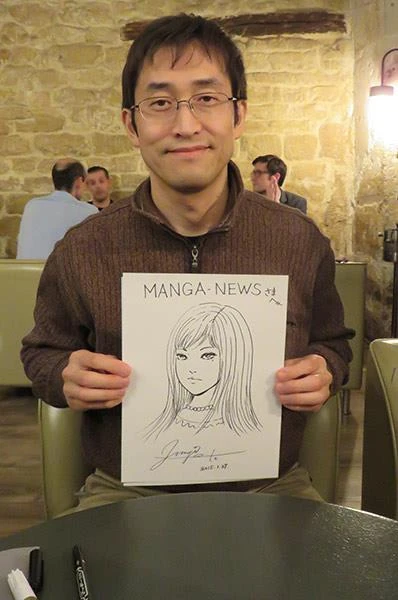
Related image
(Ladies and Gentlemen, Meet Junji Ito, My first Fragment of Horror)

This is the Manga Artist and Writer Junji Ito. A Pioneer and creator in making his own style of horror. It's a interesting mesh and combination of horror techniques from people like H.P. Lovecraft with Spectacle Horror and taking elements of Body Horror from people like David Cronenberg and Surrealist/Monster Horror from H. R. Giger, the creator of Alien. His style is the combination of the words I mentioned for horror. Visceral, Unnatural, and Grotesque. And to make his fame even more infamous, he is collaborating with Hideo Kojima and Guillermo del Toro for Death Stranding, the video game they have collaborated upon since Silent Hills was canceled. In fact, one important detail that stems from such hyperrealistic depictions of body horror in his works stems from his work as a dental assistant while also inking his own manga shorts to Manga Papers.

Now this article will be dedicated to 4 of his stories that I find best detail the psychological and body horror elements. I have the look at "The Library of Illusions", the "Ribs Woman", "The Enigma at Amigara Fault" (Please click on them in order so you can read the stories and have an extra step into understanding his world and also, it wouldn't be fun to analyze his work if we don't read it right?) and the only long story to be considered a novel Uzumaki. These stories I have chosen have been ones I have read and researched as well as have gotten with my sources to help with the stories! But to let you guys know, about two paragraphs will be dedicated to a simple summary for refreshment and I'll go into what makes these stories tick as well as what makes them pretty profound in Ito's themes and common tropes.
Image result for the library junji ito
(The cover page of Library of Illusions by Junji Ito)
"The Library of Illusions" is featured in his anthology New Voices in the Dark: Splatter Film. (This is a rough translation since mostly independent translators and fan translations primarily have translated the title as well as many of his works other than his more popular ones like Gyo, Tomie, and Uzumaki or his more modern anthologies like Fragments of Horror which my article series has taken tribute from. However, I feel in order to get the full experience from these stories, I would like my readers to find them first. I will include links to the stories so you may read them. Then once you're finished with the first 3, you may decide or not to read the 4th but it depends on your time and your tastes because Lovecraftian Horror is quite spectacle-driven and the imagery is a lot more gruesome due to the length of the story. (Honestly, I find it a bit gruesome to finish. Uzumaki that is but we'll get to that later.)

So in this little yarn, a young couple, newlyweds, are living in the husbands family house. The husband, Goro, inherited a massive library owned by his parents, 150,000 books of all kinds inside with first editions galore and has preserved them wonderfully. When two books disappear, both his parents favorites, he freaks out and Goro and his wife, Koko, search for them. But then he shows up with both love and affection and later clawed and scared when he claims the two books came to life as personified people affecting him differently with his mothers favorite book, Wintertime for Rene, symbolizes the joy and happiness Goro had with his stable family before his mother divorced his father. But his father's story is a psychological monster horror called Hellskin, and Goro's father would abuse his son every night with reading passages.

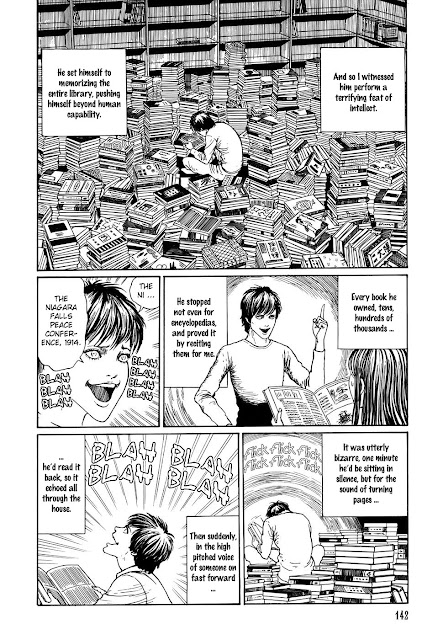
After fighting the ghosts of his past, and the books, with reciting their respective books back to them, Goro wants to make extra sure that he never loses a book again. But how does he manage such a feat when he organized and memorized the location of each book? By reading all 150,000. Encyclopedias, Atlases, Horror, Fantasy, Dictionaries, Histories, ... all become part of his mind. But as soon as he starts this mission, he already descends further into insanity, a fear his wife was constantly noticing with his neglect upon himself and her. But now once he finishes his goal of all 150,000, he has completely, lost his psychological/mental humanity. His obsession consumed, he is now at the mercy of his library, reading and reciting knowledge repetitively but normal speech patters and remembering his own name and wife are foreign to him. Trying to make sure the library doesn't consume him, Koko burns the library. However, Goro stays behind and is burned to death along with the library his family preserved. But now that the police arrive, Koko explains the unbelievable accounts and even says that the only surviving relative is Goro's father in the hospital, and in the final panel, we see what could've happened to Goro, a shell of a lost man, with only a library obsession holding him together.

Image result for the library of illusions
(Goro and Koko are about to be stalked and worse with Hellfire on the loose)

So while you're digesting the imagery here, you've noticed the worse that Ito has done with inking his stories is the creepy Hellfire with his shriveled face and the father who looks pretty similar to the book he used to abuse his son. As I said earlier, this is but a taste of what's to come but I wanted to suggest this more for the psychological horror than the monster horror. As a voracious reader in my past, (and sometimes today) reading this story affected me more than usual, especially as an analyst and a reviewer. And using the books as a obsessive way into insanity makes it more compelling on my end but why? Well, it's in part of Ito's philosophy on horror. When Ito makes a story, he focuses on a mundane event or item in life in general, usually with a positive connotation like with book reading for example, and turns it on its head for the madness and show to begin.

With Ito's work on The Library of Illusions, we see the simple and enjoyable task of reading a book, and many of us love a good story, and takes it further with making it a task that could lead to insanity with pursuing knowledge, even if it is to destroy psychological monsters from your parents favorite books, just with how Ito makes Obsession lead to Insanity. But that draws us in because of how Goro is falling into the spiral of madness. Goro attempts to fight against his monsters by pulling further into the void and thus he becomes it, enraptured and becomingly enamored by it. And this is an important aspect of Ito's work that comes from his big influence, Lovecraft,: the spectacle story.

Related image
(Goro listening to his own madness and beginning to lose both identity and sanity.)

The spectacle story isn't like a traditional narrative due to how the main characters aren't fully dimensional and are caricatures. We know nothing of backgrounds, personality traits other than general madness from Goro and concern from Koko, and even their looks, and we see this a lot in Ito's works, are very generally plain and simplistic. But this element from Lovecraft is done paradoxically, making us ever enamored into the story. And maybe it's for the better that we don't get too sympathetic with our characters. If we do, once they die, we have no interest in the story anymore. The connection is gone. But with the spectacle story, we get the opposite for the spectacle in of itself is what draws us closer to each characters fate, and luckily Koko is one of the lucky characters for many of Ito's characters often must succumb to their fates of punishment, insanity, torture, or even death (and it's usually a death that rivals the fate worse than death).

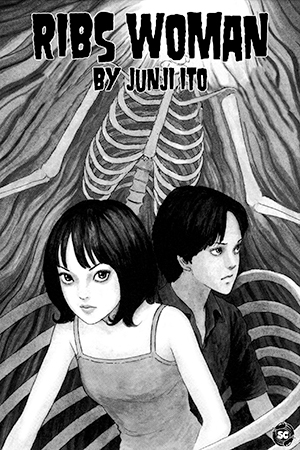
Image result for The Ribs woman
(The Title Art Picture for The Ribs Woman story by Ito. The two protagonists, Yuki and her brother Keisuke)

"The Ribs Woman" features more of the body horror elements that many fans of Ito expect and the tale is as mysterious and vile as the titular character herself. While also being an urban horror myth style narrative, the "Ribs Woman" also adds another element of Ito's work, social commentary. But this commentary, though predominantly applicable to Japan, has some parallels to even the West's issues.

In the Ribs Woman, Yuki is jealous of her brother, Keisuke's girlfriend Ruriko. She loves her but she's jealous about how she has the perfect frame and decides to have cosmetic surgery to remove her lower ribs to have a more appealing frame. A couple of nights after her meet up with a specialist, Rumiko keeps claiming to hear a mysteriously creepy song from somewhere, unlike any instrument she's heard but stalking and horrifying her. As they follow the sounds, Yuki and Rumiko lead the way, Keisuke hears nothing but tags along for protection, to the park and find a mysterious woman playing a strange harp with one string and bent weirdly. She laughs and disappears but they find that the peculiar harp is a rib bone with piano wire tied to plunk it. Rumiko destroys the rib and makes sure that her boyfriend and sister never tell about this strange occurrence. But after she destroys the rib, the next day she doesn't appear at school and it would be a couple of days later that Rumiko would be found dead with all her ribs taken out of her.

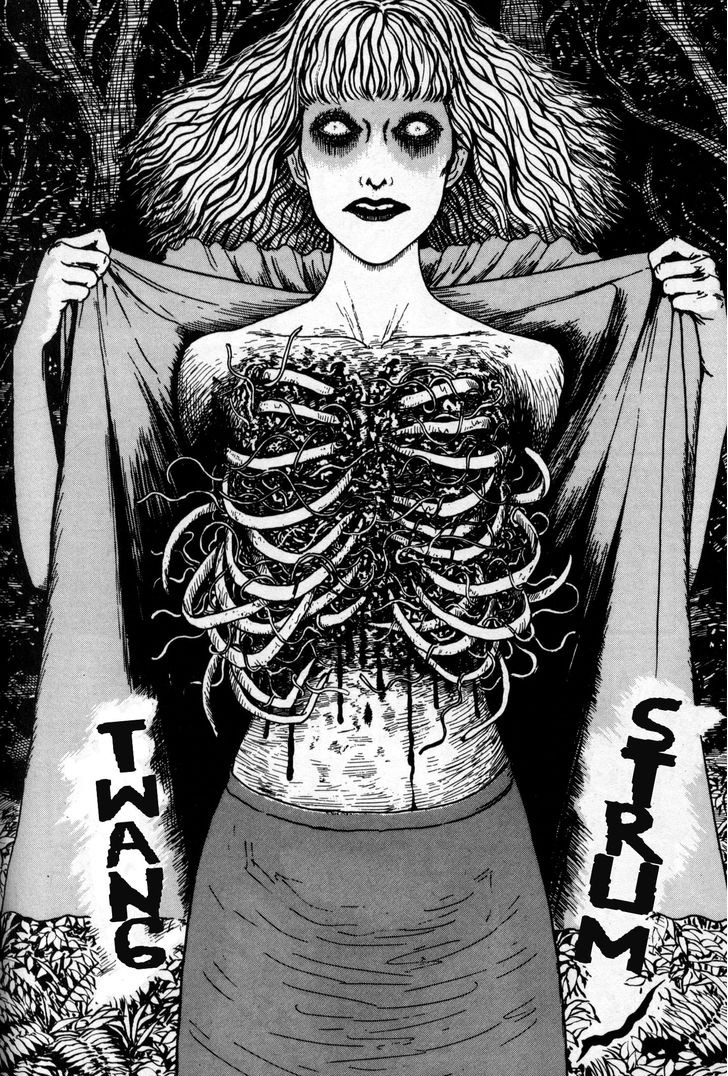
Despite all the shock to her, Yuki still goes to her specialist and he reveals the revelation that he was the one who help with Ruriko's rib removal surgery, thus giving her the new body frame. But he also mentions, quite oddly about another patient he had, his first ever and his first failure apparently. Yuki is pleased with her new body and look but it's not to soon when she hears the music again. Yuki travels alone to find the mysterious harp player. This time she reveals the new rib harp she's playing is Yuki's own, just like when she played with Ruriko's earlier. But then she reveals her purpose and nature for attracting them both with a swan song. The titular Ribs Woman opens her blouse to reveal a mesh of Rumiko's rib bones and piano wires that disturbingly turned her into a human harp. Calling out to the doctor who helped Yuki, the Ribs Woman wants Yuki's ribs inside her body. Complying he agrees and Yuki is nearly killed but Keisuke finally comes to her rescue and the doctor is arrested. But the Ribs Woman is still at large and if you listen on eerie Tokyo Nights, you can hear her demented rib harp play out.

Image result for ribs woman ito
(The intertwined ribs of the Ribs Woman)

Hehehe. So this tale now goes into the elements of Ito's hard work and hyper-realistic detail when it comes to his body horror. That rib cage she has sure does scare one out of their skin. (Hopefully once you're out of it, she doesn't try to steal your ribs ladies.) The story has elements of urban legend, kind of similar to a more modern take on horror, the Creepypasta tales of now. The tales are kind of similar to spectacle stories of Lovecraft, with the monster and or the event in question being the similar circumstances of leading our readers into the abyss of horror. But it also goes deeper with social commentary, mostly dealing with Japan's issues on beauty culture.

For in the manga, Yuki so desperately wants to have a thinner waist and thinks that removing her rib bones are the way to go. Now doubt a foil to our Ribs Woman, but instead of going obsessive to murder other women for their lovely ribs, Yuki wants a gratification and recognition of beauty on a tamer level. In fact, some of Ito's works do feature social commentary and warning through his stories but some are interpretive. One that I won't go into but you may read for your own terror is The Hanging Balloons, many have used it as a metaphor for Japans growing problem with Suicide. And those who know the main issues of the Japanese Culture of Collective Harmony vs. Individual Cohesion as well as overwork stress, and any form of dishonoring has lead people to commit a horrible act and is a huge blight that Japan still deals with and tries to solve.  But going back to the beauty metaphor of Ribs Woman, in Japan, there is a constant cultural critique of beauty and how it should be applied to young women and mothers. The popular Kawaii (cute) culture has been such a problem with young ladies and mothers with being adorable from all parts of society. It's a slight parallel but pretty potent if you know the social news and issues of Japanese culture.

Ito himself, with his reclusive nature, brings all kinds of things to the table with the social parts of his tales. It's not always prevalent like with other stories like the upcoming Uzumaki, "The Circus is Here", "Bubble Blood Bushes", and "The Beautiful Boy at the Crossroads." But all still feature the common trope of taking the mundane and everyday and spinning it on it's head into a horror story. In fact, Amigara Fault deals with another common occurrence in Japan, as well as here in my native California, Earthquakes.


Image result for enigma at amigara fault
(Cover Photo for "The Enigma at Amigara Fault")
"The Enigma at Amigara Fault" features a combo of body and psychological horror. Dealing more with playing around with fate and fatalism as well as being interpreted as a metaphor for Freudian Psychosis, "Enigma's" Tale is just as enigmatic as the story claims but the details are far more gruesome. Featured as a small distraction from the madness of Gyo, Amigara Fault focuses upon the recent break of the fault after an earthquake, and the people who are called, with an instinctual premonition, to check it out.

The story focuses on Owaki, a young boy (featured on the cover picture) and Yoshida (the girl on the cover behind him) as they both go to Amigara Fault. However, their small little curiosity of the fault get smacked into dark implications as Yoshida explains how she sees her hole in the fault, and many holes are there which has gotten Japan's Geological Society investigating why the peculiar human-shaped holes are there. Following a dream Owaki has, it's inferred though not fully that the people who come to Amigara are all supposed to be into this fate and go into their holes and day by passing day, more and more people break down into insanity as some try to pry them away from the holes but they all exclaim the same thing after they strip to their underwear. "This is my hole!"

Hoping to get past this nightmare, Owaki and Yoshida room together, the last ditch effort to fight the impulse and struggle for survival. But when Yoshida disappears, Owaki discovers she has allowed instinct and her own negative thoughts to pervade her. Depressed, he drops his flashlight and in an even more disturbing and fated response, the light flashes onto something that looks like it could be his shadow; his own personal hole. Owaki is also fated to join the others and thus he slips right into the abyss of the hole. Months after the geologists discover the back of the fault but what protrudes from the holes is mentally scaring to them as they see the fate of the humans who went inside, their bodies contorted and crushed by the fault lines now a very far cry from their human selves.


Image result for amigara fault
(One of the fated people about to enter his hole)


The "Enigma at Amigara Fault" focuses on the horrific body horror at the end similar to how "Library of Illusions" presents itself but with a twist on how deformed the bodies become. Physical bodies now deformed thanks to a curse that made reincarnated people go inside to be tortured. In fact, it should be noted that the word Amigara comes from two Japanese words meaning Empty Shell, reflecting their newfound loss. But this is where interpretation is a bit more interpretive as to why and what could the story possibly tell. As I mentioned in The "Ribs Woman" not every one of the Ito stories has a definite interpretation, such as the social commentary of the destructive powers of the beauty industry and self image. And some like "Library of Illusions" are just pure spectacle. No deep analysis or message really there other than to psychologically question our own sanity. But in the story, we see the struggle of Yoshida and Owaki with trying to bring meaning into their lives.

Yoshida has been neglected by both family and friends. Parents barely showed attention, friends didn't pay too much mind. Her depression leads her to a symbolic suicide through Amigara Fault. Although it seems like all are alive and conscious though they are hardly recognized as human. In fact, this story uses her, Owaki, and other minor characters of the story to portray a concept from Freudian psychoanalysis, Eros and Thanatos. (I'm not a psychologist so this is a brief and general explanation and we won't go into the Id, Ego, and Superego much when talking of these two drives.)

Eros is the Life Drive of Freudian psychosis. Named after the Greek equivalent to Cupid, Eros Drive focuses upon life driving and survival instincts. Sex, Food, Family, Philosophy, Religion, all these and more supplement the life drive in the promotion of making humans more rational and life affirming. Such is necessary for them to live and flourish and create something of themselves. We see this with Yoshida and Owaki's romantic attraction and when he covers the hole of Yoshida so she doesn't get called into it. But also when they spend the night together, one might look to sexual and romantic confirmation of the two being together in surviving their ordeal.


Image result for the enigma of amigara fault
(The Final Panels of the Story with the newly metaphorical zombie coming out of the crushed faults of Amigara.)
But Thanatos, named for the Greek God and Personification of Death (some might think of him with a scythe but that's actually Kronos, Zeus' Father. Thanatos is Nyx (the Night's) son.) Thanatos is the Death Drive but his death drive doesn't always mean literal death like how none of the characters actually die but face a fate worse than death. Thanatos Drive is characterized with the emotional instability of wanting life, (envy, hatred, anger, depression, and other such emotions) tangling at us to destroy the Eros drive and return to the Primitive times of man, simple but with little to truly affirm a true sense of life. (One can argue and make parallels to one of my personal favorite concepts to talk about: Nietzsche's Ressentiment.) The characters give in to their emotional issues and commit to a physical type, emotional, and psychological suicide by allowing fate to seep into their subconscious and allow the fault to fragment them into the creatures we see at the end of the story. Empty Shells who have allowed fate and compulsion to overtake them. And now, the best for the last, now that we look into the ideas of Ito and parts of his personal philosphy to enter the main masterpiece, Uzumaki!


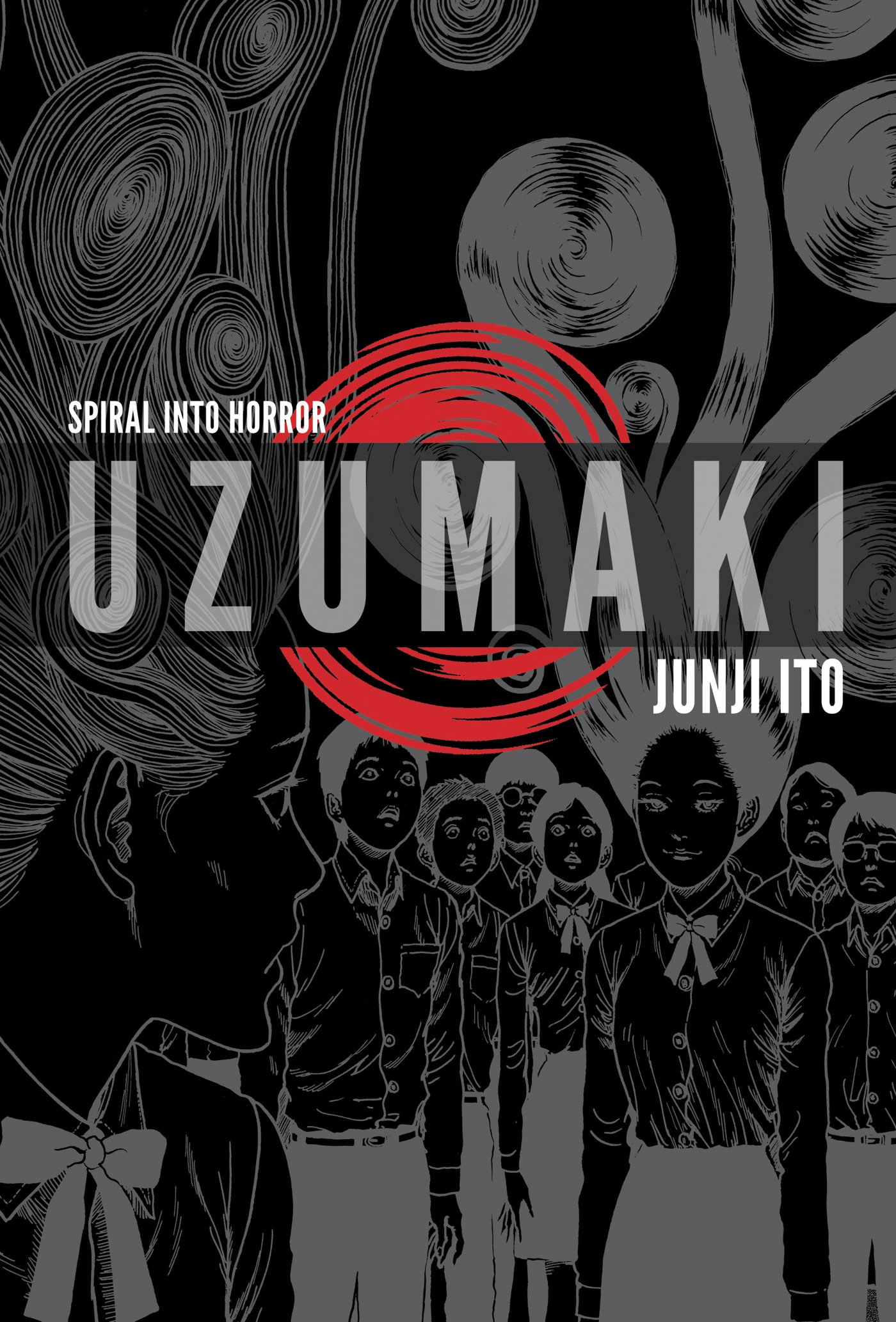
Image result for uzumaki ito cover
(Cover of the Uzumaki Special Complete Edition featuring the Hair fight scene in the manga)
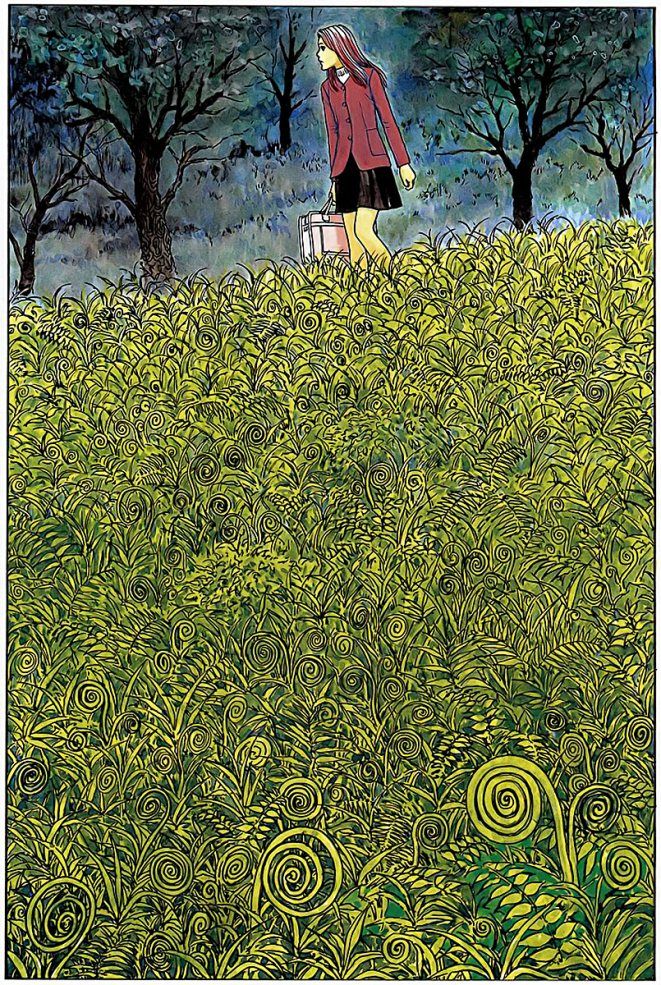
Now we come to the final part of our first article, Uzumaki. I had to save the best for last and it will feature the most visceral pictures of the bunch so viewers discretion is advised. But let's foreshadow the plot with the picture and see what do you think the foreshadow is. For those of you who know Japanese, this is a piece of cake. If not, well just look very, very closely.

Image result for uzumaki ito
(The First and one of the few Color Inked Pages of the Uzumaki Manga. Note the foreshadowing in the grass.)

Yup. All those spirals. All in the grass and that's but the tip of this iceberg. You're probably wondering how does he turn a spiral upon its head. Well maybe hear what he says about the inspiration for choosing the spiral for the central driving force of the story. To summarize, he noted how in traditional Japanese media, the spiral is a general symbol of rosy cheeks and happiness. In general, its a positive force.

Image result for uzumaki
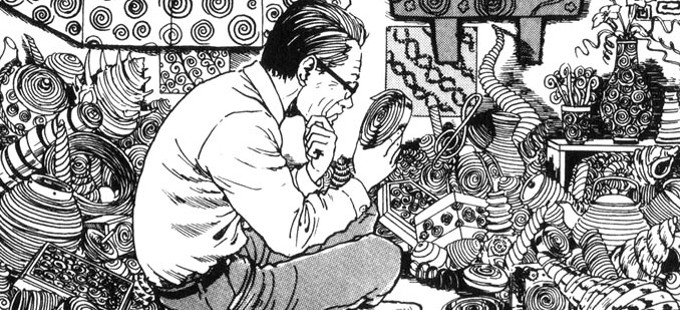
(Shuichi's father, a pivotal character, collects all the strange and unnatural phenomena of the spiral from sculptures, nature, pottery, etc.)
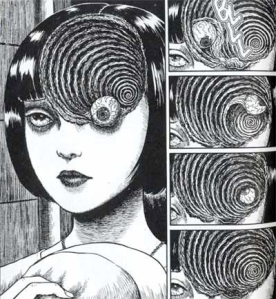
But in Uzumaki, that is drastically changed. All the spirals you see in the above pic are all about to make you feel even more at unease as you look further and twirl down into the spiral of this story. The story itself is an episodic nightmare, slowly delving further into insanity and twisted body and psychological horror. In fact, I sometimes feel the episodic plot reminds me of Dante's Inferno. Not fully in the whole traveling through hell but each new chapter introduces us to a new form of punishment and perversion of human life every time so it's not always the same thing over and over again, with Ito finding new ways to use the universal spiral, as a universal form of punishment.

Image result for uzumaki hair
(The Medusa Spiral effecting one of the girls in Uzumaki.)

Every Chapter in the story focuses upon two protagonists, lovers Kyrie (pronounced Kyr-E-eh) and Shuichi (pronounced Shoe-E-Chi). Kyrie wishes to leave her seaside town of Kurozu-cho, (pronounced Kuro-Zoo-Cho) a seaside town in Japan. (This is where Lovecrafts similaries come in for Lovecraft made most of his stories in New England and the story The Shadow over Innsmouth is a parallel to Kurozu-cho's seaside locale from the town of Innsmouth, Massachusetts.) Both of them discover more and more about the phenomena of the spiral from Shuichi's father and it seems like every, new natural and human made spirals surround the city until the intents and purpose of the Spiral's grand plan unravels.

Image result for uzumaki ito
(The Spiral Absorbs one unfortunate girl. Even looking at this makes me both nauseous, dizzy, and creepily disoriented.)

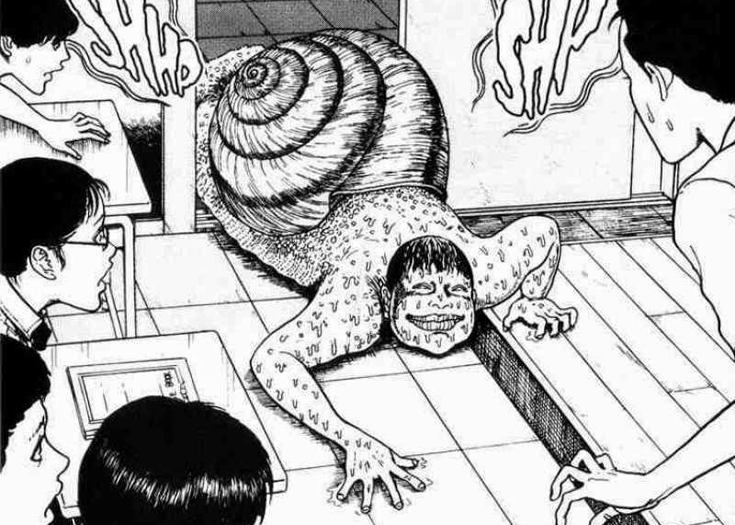
And As I said with making a parallel in the episodic style of the Inferno, it feels like we ourselves are like Dante, with Kyrie being our Vergil and going down the timeline with a new punishment being made around the spiral in some way. Shuichi's father loves the obsession he has with the spiral he contorts his body into it as his final wish. Shuichi's mother sees it everywhere and tries to get rid of the spiral (Cutting finger and footprints off) once and for all but it still haunts her even til death (I'm gonna let you read Chapter Two: The Spiral Obsession to see what I mean). Natural Disasters like Hurricanes and Whirlpools cause the attacks and deaths of people. Hair is tangled into Medusa like control, the spiral can literally eat someone and disappear in a few moments. People turn into snails slowly and painfully and anyone who messes with the newly transformed snails gets turned into them. Pregnancy isn't even safe and vampiric mothers take corkscrews to screw out holes and eat the blood of all types of people. And people rip themselves out of their bodies, with their spines turned into coils and springs to hop around.

Related image

Note how all of these use the spiral in different ways. A new punishment for each new story. And each picture you see incorporates that feel. Body and Psychological Horror are used to the up-tenth to display the Lovecraftian turn of Ito's masterpiece. Ito creative uses for subverting the spiral have been well done to accomplish his inversion goal: unique, creepy, and psychologically haunting. But this goes with all his stories. Maybe they don't require the same attention Uzuamki or Amigara needs for body horror. Maybe they don't always have a more veiled message like "The Hanging Balloons" or "Ribs Woman." But all in all, Ito has allowed us into his world of fatalistic and maddened protagonists as the spectacles of their lives either haunt them or have already killed them.


Thank you for reading and enjoying my first Fragment of Horror. But don't leave so soon. I have 12 more articles for you to enjoy and I hope I do my best in promoting them. So comes to the end of Fragment 1: Junji Ito


And for further looks as well as some great videos/works cited for me:
 Check out two of my favorite YouTube Channels: Ragnar Rox and Tale Foundry

RagnarRox is an analytic media YouTuber focusing on horror  in video games and movies. Check out some of his work on I Have no Mouth and I Must Scream the game and his Monsters of the Week Series for some great content. He's also done these two great videos on Junji Ito that have been so well polished.
Junji Ito: Spiral into Horror
Junji Ito's Amigara Fault & The Horror of Compulsion

Tale Foundry, on the other hand is focused on analyzing the tropes of story styles and for beginner authors like me, I love the research and focus for new types of stories from examining Ito and Creepypasta to Weird Fiction and Celtic Lore. And each analysis comes a short story written by the team to listen and enjoy.

Ito Videos
Do Junji Ito's Characters Actually Matter?
3 Ways Junji Ito Disturbs Us
Sillouhettes: A Short Story

And check out my last suggestion and video
How Media Scares Us: The Work of Junji Ito

Friday, September 7, 2018

Top Ten Non-Square Enix RPG's


Top Ten Non-Square Enix RPG's

Hello everyone. It's time for a Top Ten. I haven't done one of these so I'll have some very pivotal rules for this one. We're going to count down the top ten Role Playing Video Games that aren't created by Square-Enix

1. The main rules will be one game per franchise if the RPG had a series.
2. The games must not have been popular when they came out until they have had a resurgence thanks to fandoms, remasters and re-releases, featuring in popular media, etc. If they have a cult following, that still counts as well.
3. It must have sold low or had barely noticeable press coverage when the game released or it might have been shadowed by previews that gave negative press if such is to be.
4. All Square Enix Franchises are off the Board. No Kingdom Hearts, Final Fantasy, The World Ends With You (as much as I love it), Dragon Quest, etc. Sorry Square Enix lovers but sometimes other companies can come up with some good RPG's.
5. This also counts for video games that are published by Square Enix or assisted with production from Square-Enix in the past so the Star Ocean Series is off the table and So is Super Mario RPG due to those technicalities.
6. Games will be rated by the importance of the game in the franchise (again if they do have a franchise), the improvements made overall, and extra boons like effecting video game sales/reviving old franchises/impact of future installments/cult classic love.

Ok, then here we go.

10. Shadow Hearts: Covenant: This game was made by ex-Square Enix employees when they started the now-defunct Sacnoth (later called Nautilus) company. This RPG has a darker tone compared to Final Fantasy but still has lighthearted moments of humor. Set in an alternate universe during WWI, Yuri Hyuga and friends get involved with secret societies, demon summoning, and saving the entire universe from Lovecraftian style situations. And Yuri must use his powers as a harmonixer, a human who can eat demon souls and turn into them, to stop all kinds of evils from members of the Ars Goetia, Rasputin, and the Japanese Government.

Image result for shadow hearts covenant
(Blanca (center) and Gepetto (left) face against one of the first enemies of the game. Seen is the Judgement Ring)
The game also features quite a bit of humor with the main cast and a couple of side characters including flamboyant twins who run a shop you visit most of the time. The enemies all have the Lovecraft vibe with tentacled plants, dolls with bugs nests inside them, large roaches and weird babies, floating zombie ghosts in chairs, the list goes on with most being palette swaps of other enemies but still do the job right.

Image result for shadow hearts covenant
(Yuri (in the Black Jacket) with Allies (from left) Joachim (blonde) , Lucia (back in the peach dress), Karin (redhead), and Gepetto (green suit) searching through a mystic mansion)

And another boon to this game is the character development. The side quests have each a character to help with either ultimate armor, weapon or ability in each case so don't shirk on them because it's quite enjoyable seeing them achieve their goals as well as some of the oddball humor that invades scenes at random times. But it's an overall fun cult classic that does deserve a PS2 for PS4 badly but we can still enjoy some nice play-throughs and occasional cosplay nods.


9. Fire Emblem: Awakening: Without this game, we wouldn't see the return of Fire Emblem and have its fate regulated to Super Smash Bros thanks to iconic characters like Marth and Ike. Though it did garner a small following in the West, Awakening was the game that gave the popularity and focuses needed to be engaging with a cast of unique and tactical characters all aligned differently to go forward with the goals of having the crest of Fire Emblem restored. However the main villains as well as a grand cast of heroes, anti-heroes, and tragic villains emerge as they all help stop the villainous plight truly behind the shadows.
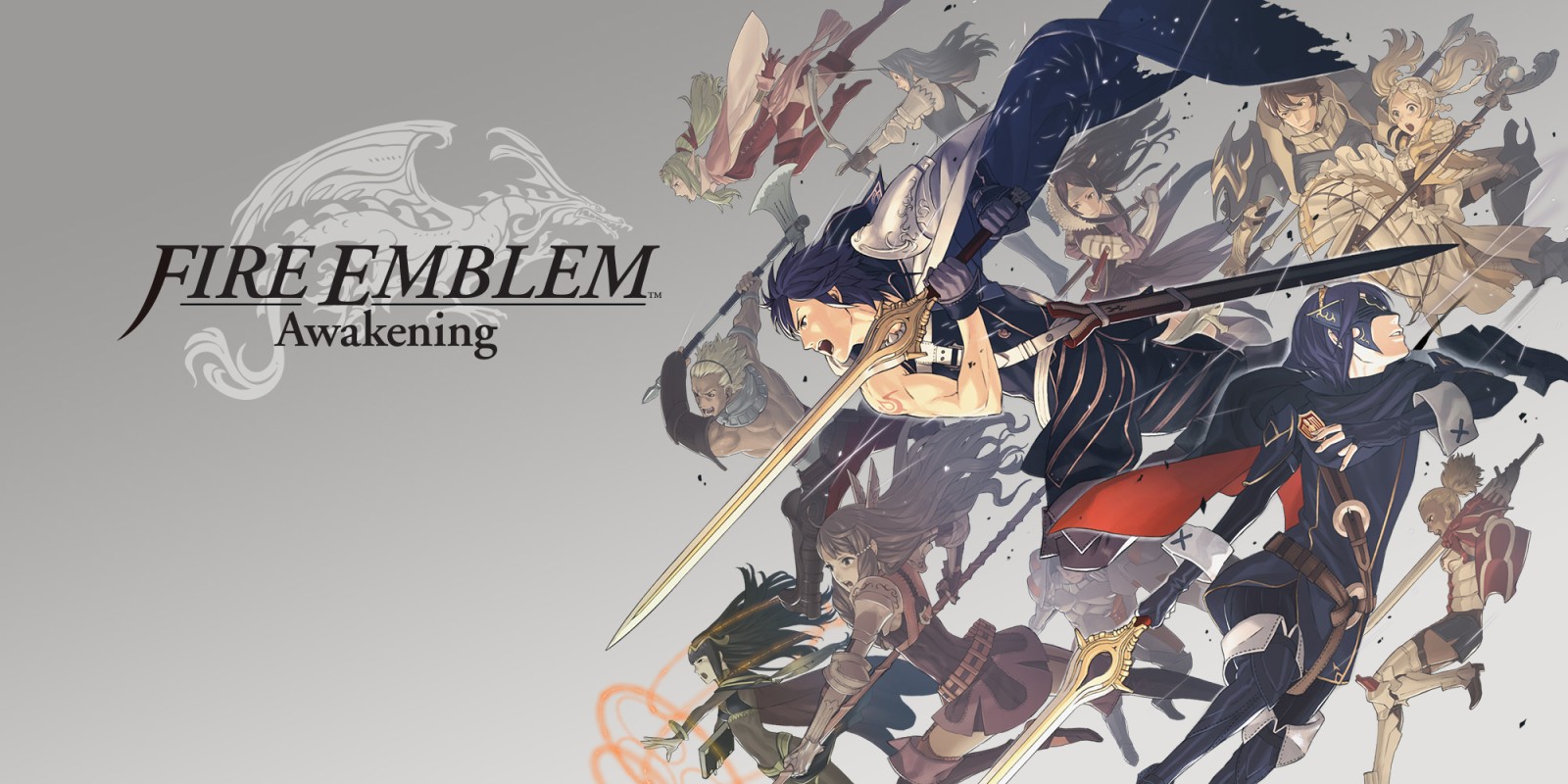
Image result for fire emblem awakening
(Logo of Fire Emblem with Chrom and other allies attacking and casting spells)
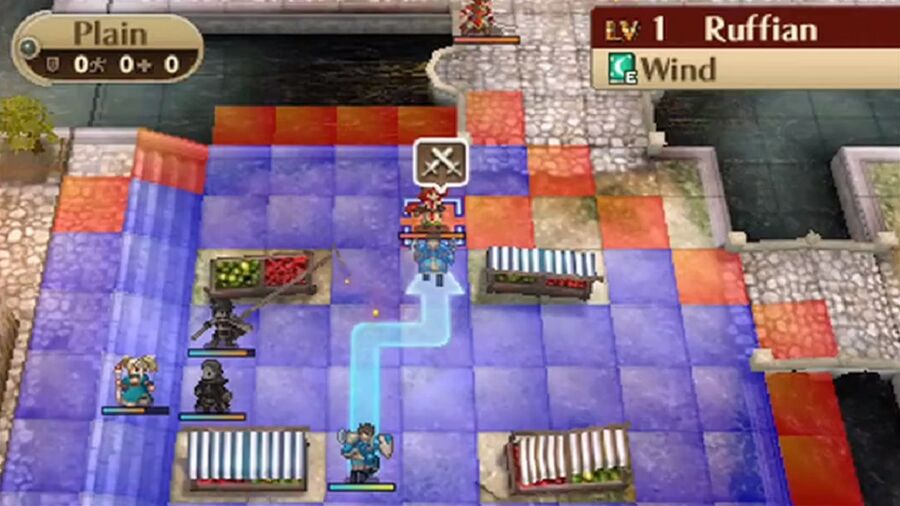
Played similarly to chess, you must control your members on a square by square board moving them to defeat enemies and grow stronger. But on the main style of the game, if your party dies, they die. IF your leaders (Prince Chrom and Robin (default name) the Tactician die, it's automatic game over. And at least one of them must be in each battle to add more difficulty to the game.
Related image
(Gameplay of Fire Emblem: Awakening, the characters must face their opponents horizontally and vertically, (diagonally if they can shoot arrows or cast spells)
But this games impact was the much needed hero of its day. This was supposed to be the last Fire Emblem Game if saled didn't go well. The Fire Emblem legacy would've died here but at least would've been off with a bang. But thanks to high sales, positive reviews, and love for each of the characters, this prompted the Fire Emblem franchise to continue with a new Fire Emblem coming for the Switch soon.

8. Mario and Luigi RPG 3: Bowser's Inside Story: Despite Super Mario RPG: Legend of the Seven Stars being a collaborative effect on Nintendo and Square's part. Nintendo has done a great job with its own RPG list, especially a future franchise that'll be in the list. But before we go there, we must go here. Mario and Luigi and Paper Mario are both great RPG franchises that Nintendo made with the trademark characters but given a comedy spin when it comes to the antics of the Brothers in Mario and Luigi or the 2-D joys of Paper Mario and friends.
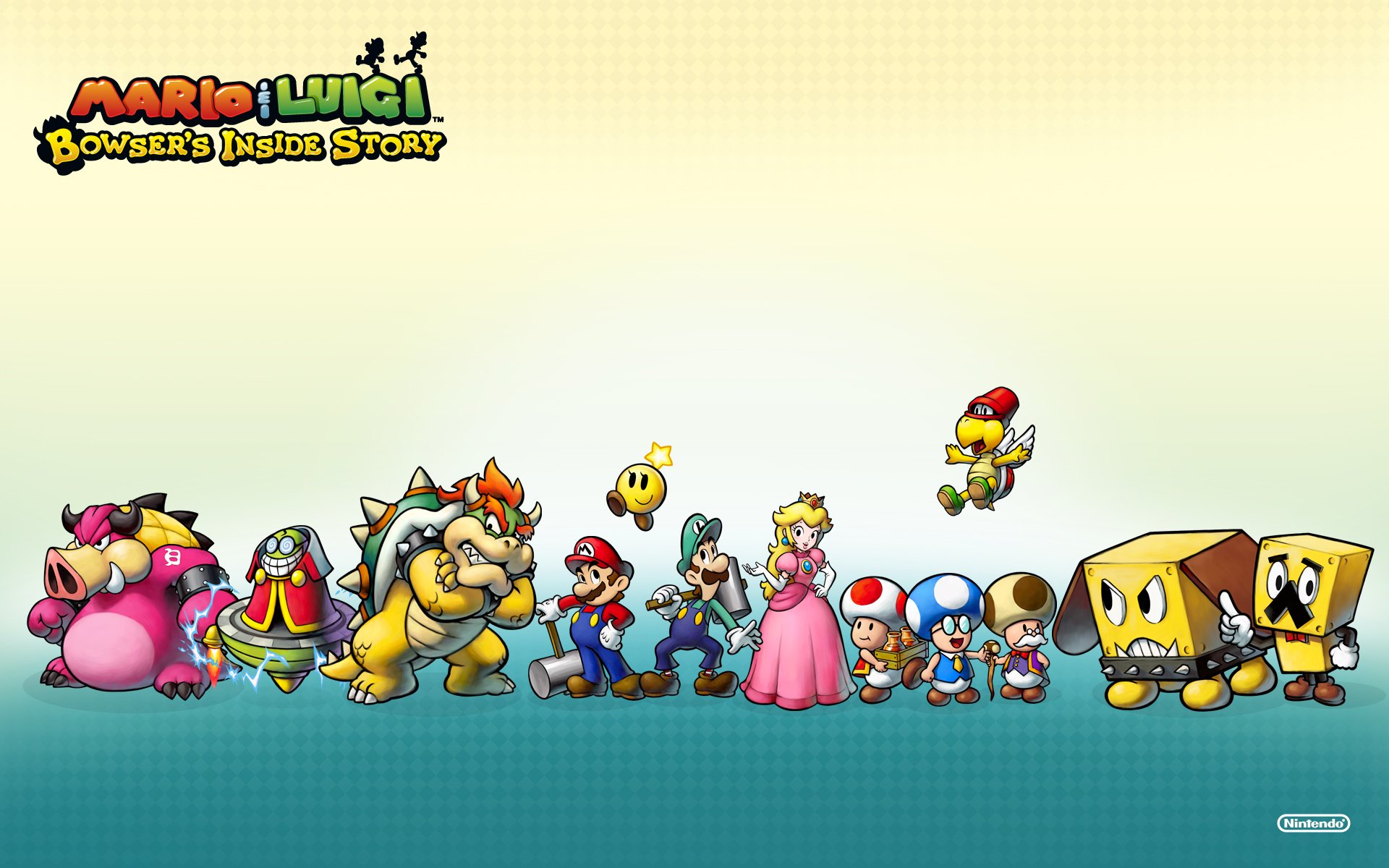
Image result for Bowsers inside story
(The Main Chase of Bowser's Inside Story: (From Left to Right) Midbus, Fawful, Bowser, Mario, Starlow, Luigi, Peach, Toad, Toadbert, Corporal Paratroopa (flying above), Toadsworth, Broggy, and Baroque Monsieur)

In Bowser's Inside Story, you play as both Mario and Luigi, but also with Bowser for the first time in way too long since Legend of the Seven Stars. Following a comical yet slightly serious tone of good vs. evil, Fawful from Mario and Luigi: Superstar Saga has tricked Bowser into eating a Mushroom that sucks up enemies. Now with an uncontrollable appetite, he storms the Mushroom Kingdom while also allowing Fawful to control both the Mushroom and Koopa Kingdoms. And an illness called the Blorbs is oversizing the Mushroom Kingdom Citizens, making them unable to fight or do anything at all.
Related image
(Gameplay showing Mario and Luigi inside Bowser and his Bone Thwomps (left) and attacking enemies controlled by Fawful (right))

For the battles, you chose an attack and if you time the presses successfully, the system rewards you with more damage against enemies whether you jump upon them or hit them with your hammer. Also the skills you do also have certain requirements to achieve max damage, from drawing lines with your stylus to hitting A and B at the right time. Also Each Brother and Bowser is controlled with different buttons, Mario is controlled by A, Luigi by B, and Bowser has X and Y.

The Game's main draw is the oddball scenario and the comedy mostly known throughout the Mario and Luigi RPG series and this one was chosen for being the funniest and being the first Mario and Luigi RPG on the DS/3DS. And to make even the Mario fans happier, BIS will be rereleased on 3DS in 2019.


7. Ni no Kuni: Wrath of the White Witch  This game combines the best of two worlds: Studio Ghibli and RPG's. Level-5 had a cult hit RPG with Dark Cloud and its sequel. However, their main popularity with the RPG world rose with this collaboration came across with a combo of Monster Hunting elements, a grand score by Joe Hisaishi, and a wonderful voiced British Cast. (I'd say that the cast brings more of the whimsical elements of the game to life.)
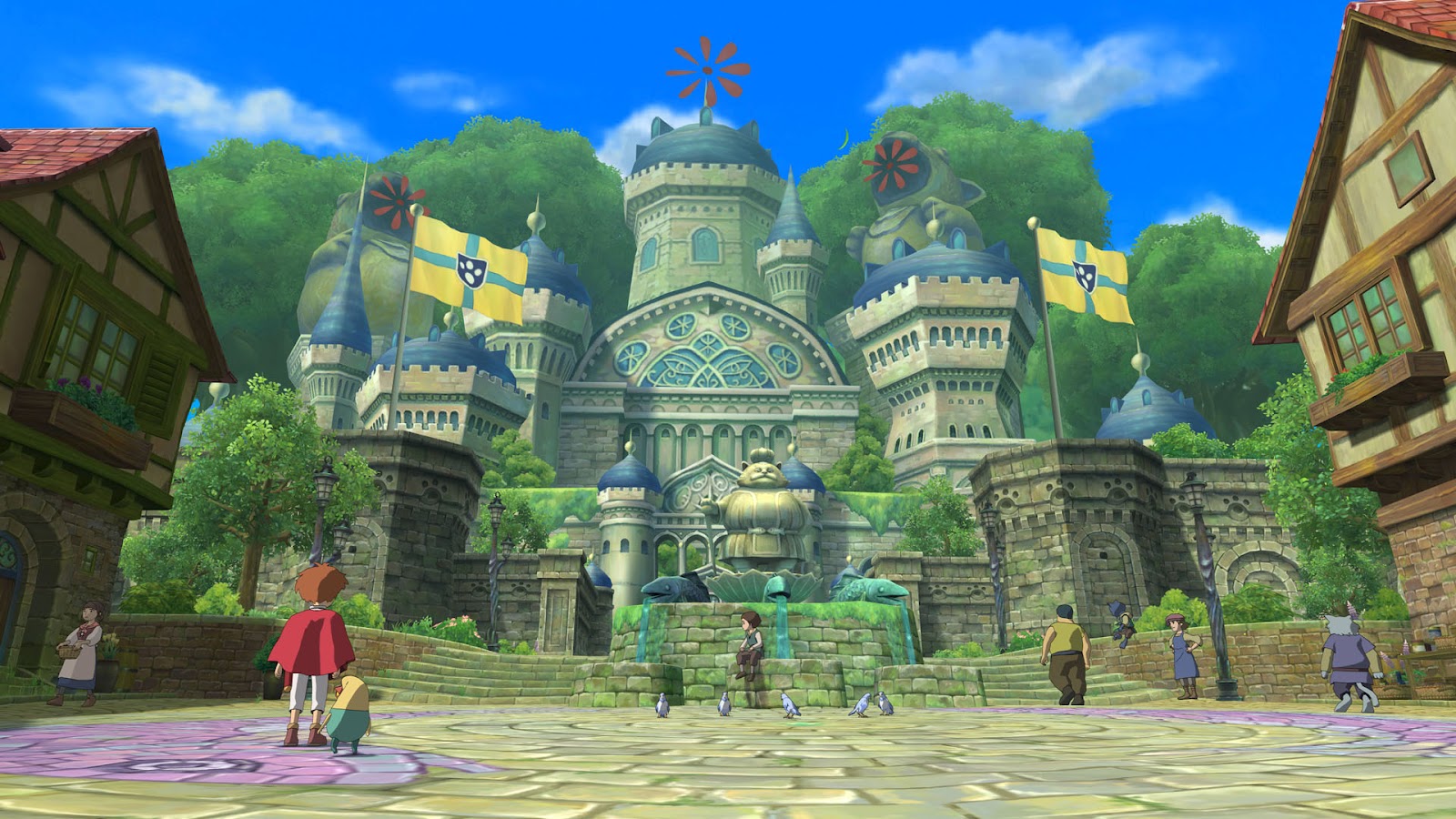
Image result for Ni no kuni
(The first main city of Ni No Kuni, Ding Dong Dell)
Focused upon Oliver, a young boy trying to revive his dead mother by finding her soul mate in The Other World (Where the title Ni no Kuni roughly translated means) he travels to find a world of heartbroken people and as a wizard, plans to restore their hears and find the Saga Alicia. Meeting new friends and going on an adventure that even sets certain magical laws as well as understanding the power of his magic, Oliver and his friends Esther, Swaine, and Prince Marcassain must fight against the the evil White Witch and her Djinn, Shadar.

Image result for Ni No kuni wrath of the white witch
(The Main Cast and some of the familars you will face in Ni no Kuni. In the main center are Oliver: (Center) Esther (Oliver's left) and Swaine (Oliver's Right).  )
The World is a Treasure Trove of Imagination, Fantasy, and Wonder. It's a wonderful Alice in Wonderland Tale of its own right and the RPG elements mostly focus on it being a real time RPG while also incorporating common tropes of JRPG's like abilities that cost magic to use. The most notable is the Monster Gatherer aspect and many of the monsters are quite interest but it's kind of sad that many of them that you collect are re-skins when they level up. But you can also upgrade certain abilities of theirs with sweet treats though certain families prefer some treats over others and must be fed that to gain affinity and higher stats.And with the sequel, this game shines due to having the back power of Studio Ghibli's hands and transitioning from Nintendo DS to PS3 updated everything to a beautiful game that could possibly be described one day as a work of art.
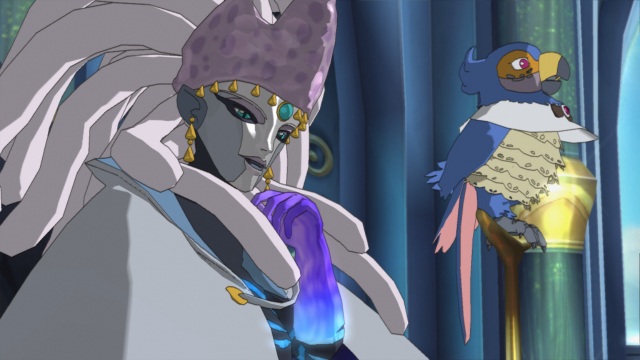
Image result for Ni No kuni wrath of the white witch shadar and cassiopeia
(Two of the main villains: The White Witch and her parrot Apis.)

6. Undertale: There have been many spectacular indie RPG's like Darkest Dungeon, Citizens of Earth, and (one of my personal favorite) Knights of Pen and Paper 1 and 2. But the one that can be considered the biggest success is Undertale. Combining aspects of 8-bit and old school RPG's like Earthbound and the early Shin Megami Tensei, the story focuses on a young child going to a land of faeries and decides the fate of its world.
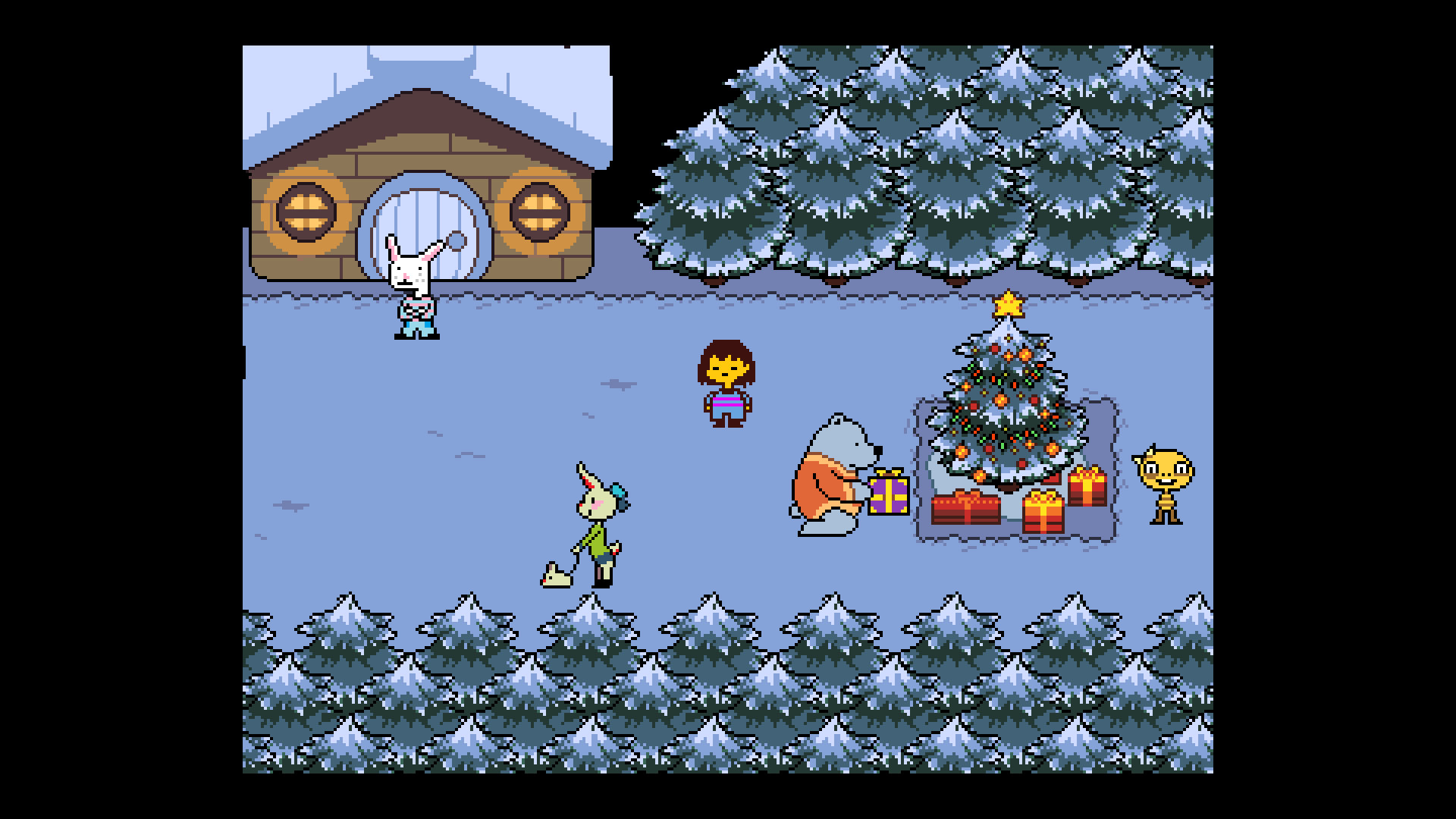
Image result for undertale
(The main protagonist going through a town in Undertale)

The Game's Alignment system is one of the highest acclaimed pieces, even bleeding into other play-throughs like how they constantly remind you of all choices, good and bad you made. With the choice of being able to kill anyone you want or being pacifistic helps develop the game on multiple levels of philosophical and ethical questions as well as character-centric storytelling that allows anyone to get to know specific favorites more and rewarding them with those special scenes and moments. And with the game being inspired by Irish and Celtic Lore of Faeries and magic, it enriches the experience of it overall.
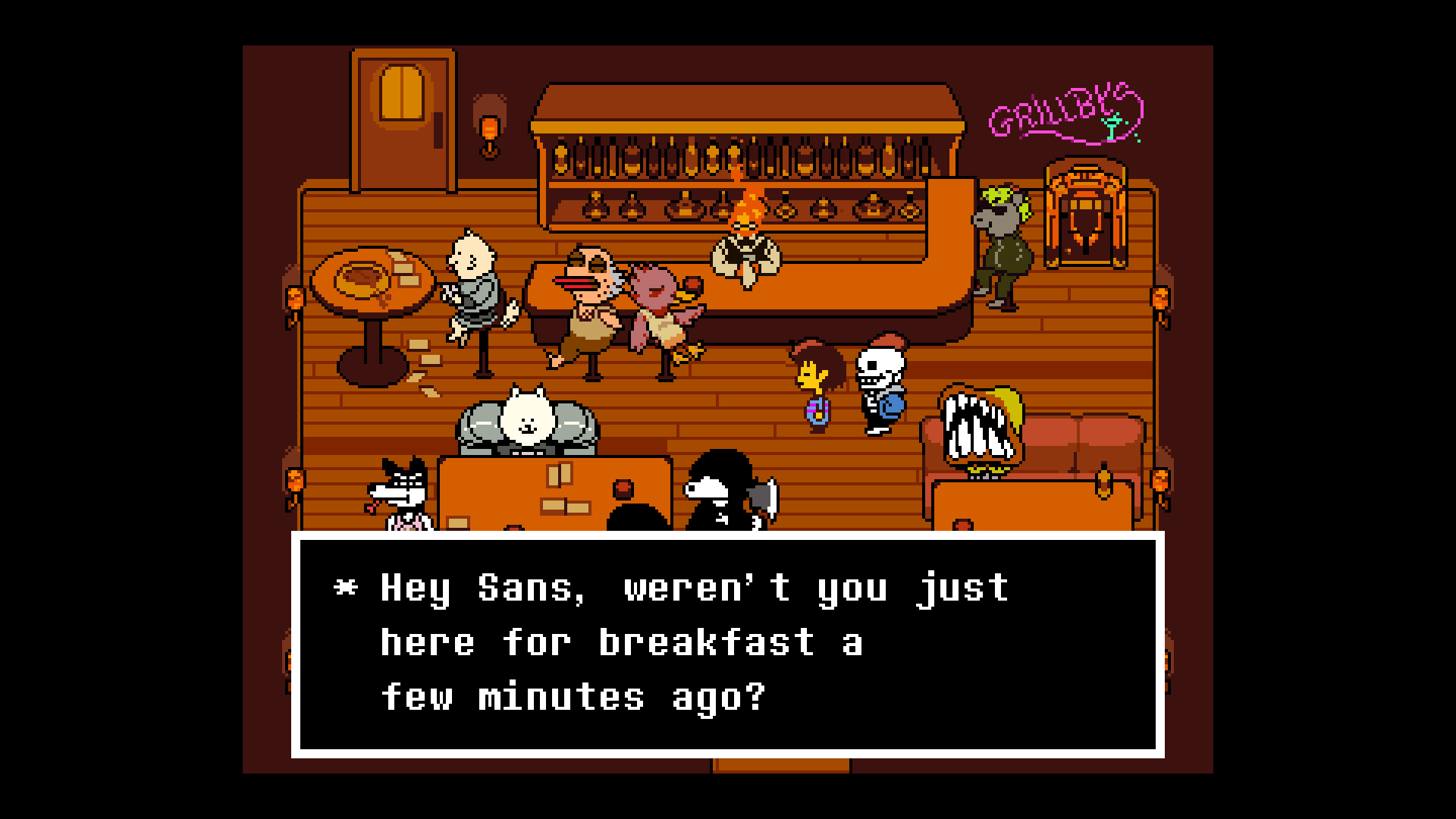
Image result for undertale game
(Sans (the skeleton next to the MC) and the MC at Grillby's bar in 
And with its success came a multitude of fan support and with one of the largest fan bases ranging from artists, musicians, and even game creators who redeveloped and made games inspiring and sometimes bootlegging it. It's made a cultural and gaming impact on us and hopefully in the better for years to come and for future indies.


5. Dragon Age: Inquisition

Bioware has had many successes in the Western RPG world. But credit is due to Dragon Age: Inquisition. Focusing on the Civil Unrest in Thedas, a customizable MC, made into the chosen due to a mark (Totally not a MCGuffin!) on his body claiming him as such, to bring peace to the land with his advisors and allies as well as stop demons from conquering said land due to the unrest.
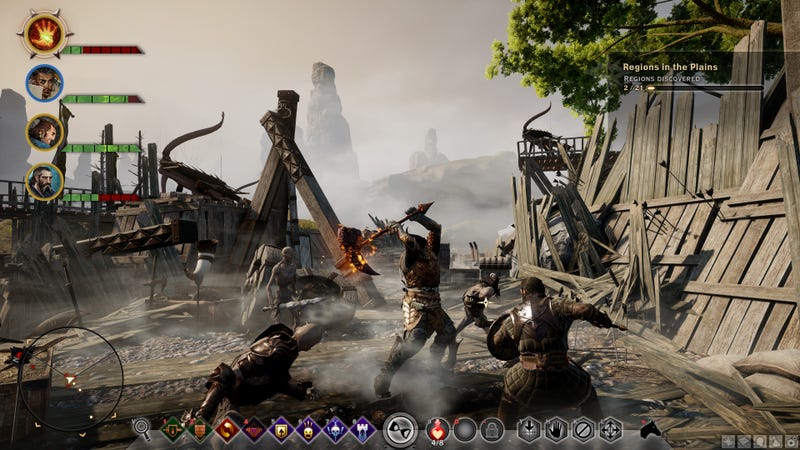
Image result for dragon age inquisition
(The MC and some of your party fighting enemy forces in DA:I)

But unlike other RPGs, since our main character is fully customizable, more emphasis is made on the choice you make such as dealing with chosing how do accomplish missions as well as dealing and talking to you allies as you forge alliances and friendships. This adds an interesting mechanism in especially since choice matters in deciding how to get Thedas to peace. Choosing one of 3 advisers allows for 3 different paths of Diplomacy, Warfare, and Spying (thought spying helps lead towards Diplomacy and Warfare, though your own allies might find the prospects of trusting you difficult.) This mechanic makes the socio-political atmosphere more interactive compared to the conquering against the blight run world of Fereldin in Dragon Age:Origins.
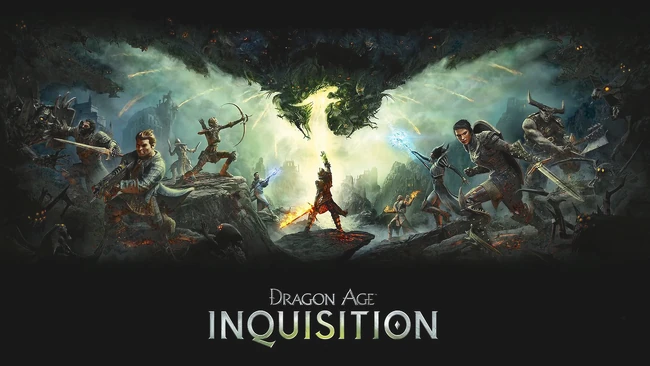
Image result for dragon age inquisition
(The main logo art of the game featuring the main cast)
Also, in this fantasy setting, there's a bit more in the social diversity range and group to anyone interested with an extensive treasure trove of editing your avatar to fit your personal wants as well as grand storytelling with each party members own trials and tribulations like Dorian confronting his father with his homosexuality to Blackwall, the devout Grey Warden hoping for peace despite his purge on the forces of evil.


4. Dark Souls: The game, the strife, a newborn legend. Well, at least it makes more sense  when you decide to look at all the parts of the information and looking at way too many lore and philosophy meanings for the story of Dark Souls. But this game has been a video game cultural icon, even if it has been overused in quote and meme culture. (I.E. This game is the Dark Souls of RPGS, even though in general Dark Souls is an RPG game.)

Image result for dark souls 1 ps3
(One of the inventory menus showcasing items that will help you survive your strife in Dark Souls)

Dark Souls did something similar to Undertale, go back to the games of the past to find inspiration. The thing they took instead however, was the archaic style of older video games: little plot, hard difficulty, and overwhelming frustration! The game focuses on a nameless protagonist looking for what he's lost as his true self in a void of death, destruction, and nihilism. The only hint of what to do is what others are saying about reclaiming humanity and finding a new path to your salvation.
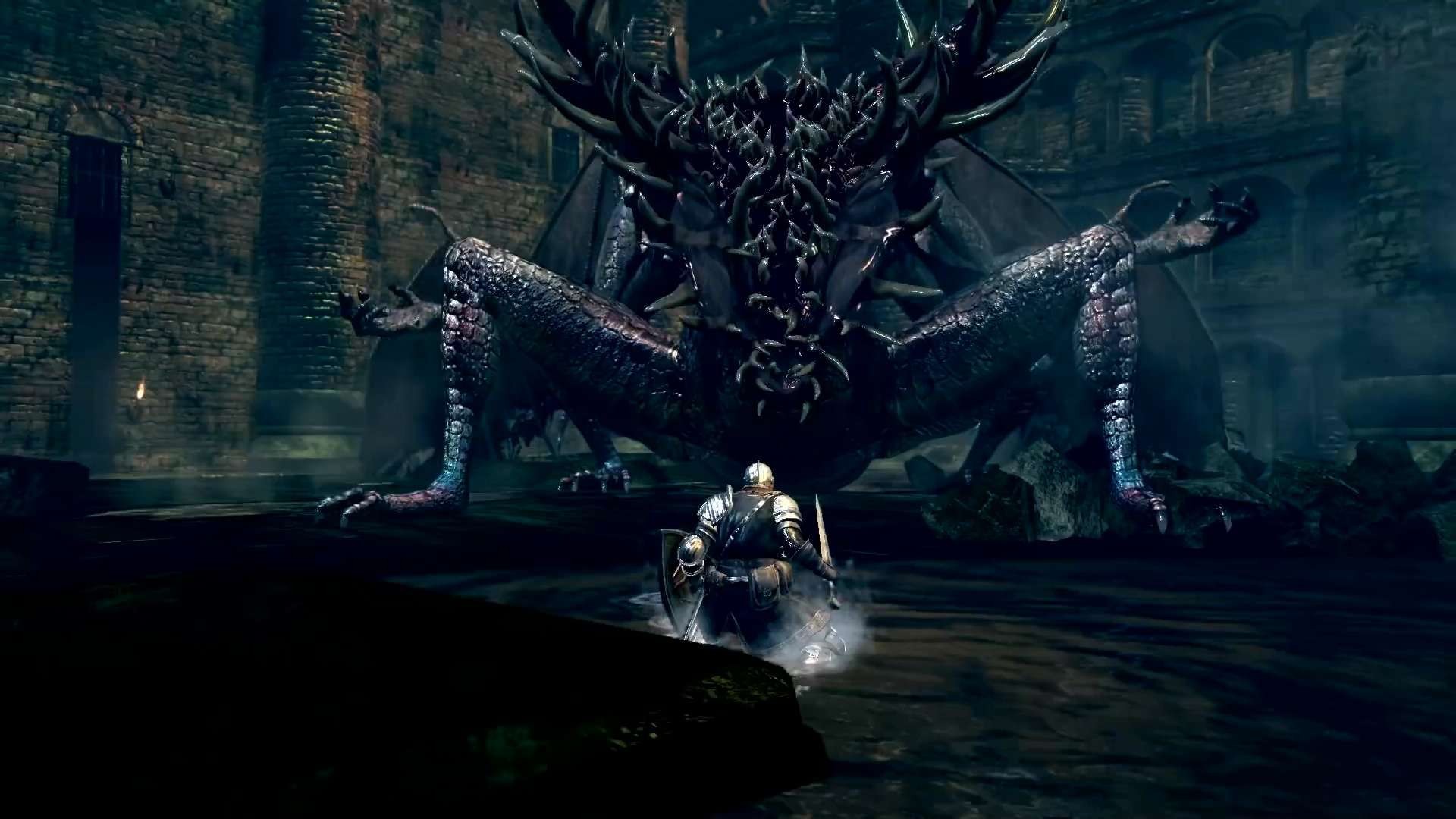
Image result for Dark Souls
(One of the Bosses you can face in Dark Souls: The Gaping Dragon. The Teeth coming out of the stomach has a slight parallel to Cthulu's tentacled form with overemphasis and body horror twists and disconjunctions)
But with the constant struggle to beat over the top, Lovecraftian style bosses from Elditch Nightmares, a constant and psycho-maddeding reincarnation cycle, and what seems like no place is safe and there is no where to really go, Dark Souls still manages to immerse us in both its world and lore and with going back to early gaming days basics, manages a challenge of both gaming and intellectual prowess. (This is due to Namco offering a $10,000 prize to explain the full plot of the Dark Souls Saga back in 2016 and that has many people from Wisecrack to Nerdy, INC to come up with the Philosophical and Plot structures of Dark Souls.) And it is to this minimalist plot requiring deep exploration and constant struggle for greatness which is what will make Dark Souls continue it's triumph for many generations to come.


3. Persona 5:
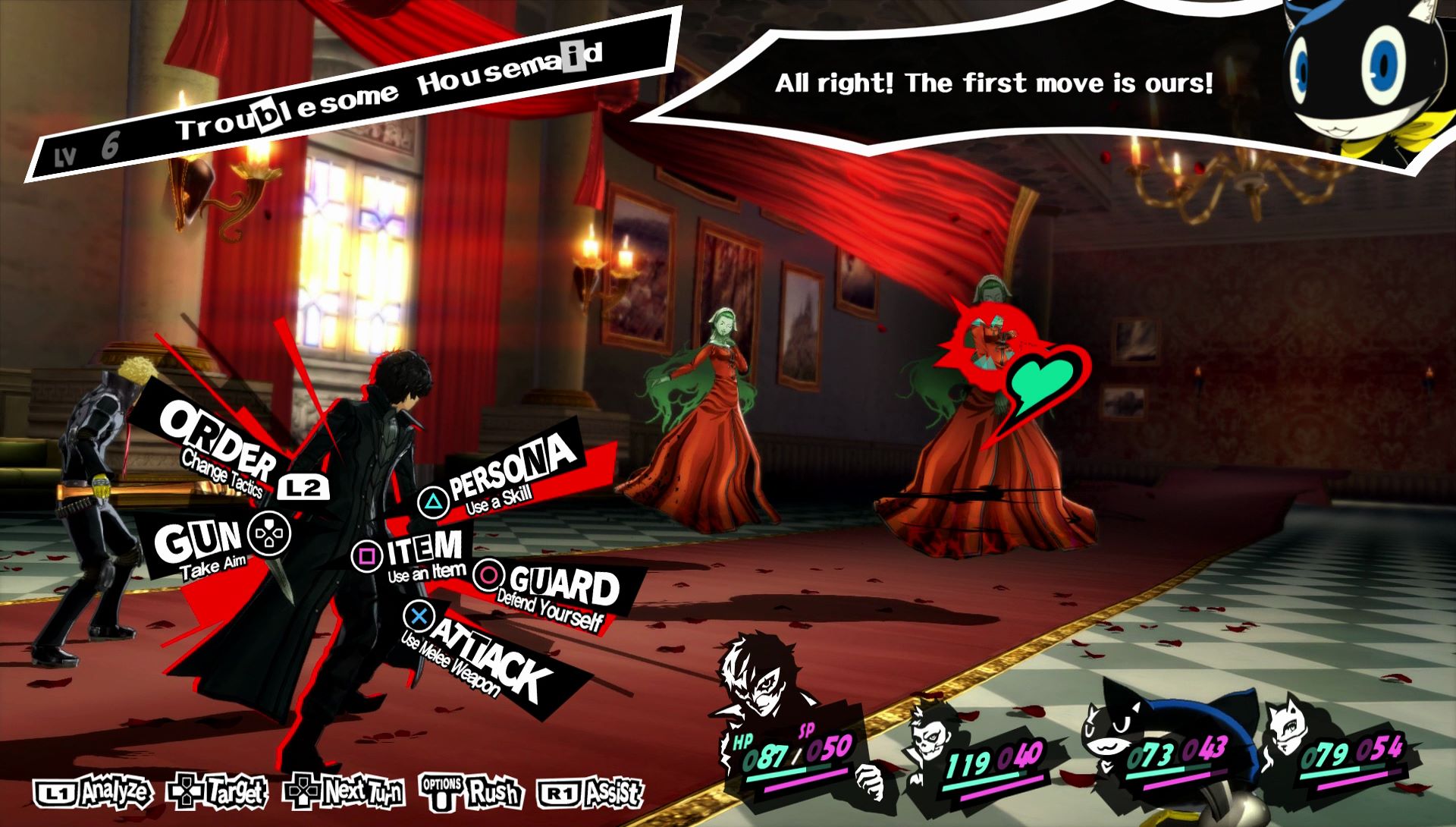
Image result for Persona 5
(The Protagonist going to attack the Shadow Silky in Persona 5. Also features the battle menu.)
The game, the anticipation, the success. This was a contender from Game of the Year by many beloved fans and reviewers alike. And with a combo of a grand plot, adding to the traditional fighting elements of Personas with reintroducing 3 attack elements, and adding extra features to make every choice count even more than the last one, Persona 5 becomes a titan of RPG greatness.

Image result for persona 5 gameplay
(The Protagonist treading around Yongen-Jaya, his new neighborhood he moves to in Persona 5)

Focusing on the memories of a vagrant youth, he recalls how he was accused of a crime he never committed and how he ended up a Shujin academy and the friends and enemies he'd make. Luckily, with some power from Igor (a mysterious owner of The Velvet Room) and his assistants, Caroline and Justine, Akira or Ren (depending on whether you prefer the Manga or Anime name respectively) becomes a Phantom Thief, stealing the hearts of criminals while making it off like a king, and uncovering a conspiracy that has allowed strange occurrences to happen all over Shibuya and general Tokyo.
Image result for persona 5 gameplay
(The Cast of Phantom Thieves talking about the next heist and the next villain's heart to steal.)
With your daily aspects, you do a life sim with day to day interactions like playing video games, hanging out with friends, working out, attending school, increasing your personal states like Courage and Intellect, and buying the things you'll need to enter the dungeons. By night you become the Phantom Thieves. Explore the many palaces of the minds of the villains you plan to reform while improving social standings with a close knit group of friends and tricksters and rebels.

2. Pokemon X and Y: If we are going to discuss Non-Square Enix RPG's, let's discuss Pokemon. Pokemon is predominantly the first J-RPG that many of us will be familiar with due to growing up with it just like with Final Fantasy, Star Ocean, or the Mana series. One on one battles in a turn-based system of knocking our enemies out. Pokemon X and Y are chosen as due to their impact on the future of Pokemon games, and what it was designed as.

Image result for pokemon x and y starters
(Pokemon X and Y starters (From Left to Right: Chespin, Fennekin, and Froakie)
This game was the love letter to Pokemon fans all over the world with the Second Generation of a Pokemon game featuring a real world inspiration out of Japan. (Unova, the first one was based on New York City and Manhattan Island and Kalos is based on France.) But the extra additions, primarily the updated graphics and the 3D realism and fantastic elements of Pokemon make it an extra special experience as well as a new update to keep Pokemon fresh and alive from transitioning from 2-D to 3-D.

Image result for kalos region
(The Map of Kalos Region)
This game's theme on Beauty makes sense given France is a capital of culture of the arts, beautiful chateaus and scenery of the French Countryside and Rhine, and the many vineyards to enjoy as well as offering DS Photo compatatbilites to have you snapshot Kalos as a real tourist destination. And it also added fashion choices to buy from the many stores you can find in the cities and towns of Kalos. And with 72 additional pokemon to the mix, people have already found their fan favorites.
Related image
(The new 3D models seen in X and Y for  Luminous City.)
And now for the Honorable mentions:

Odin Sphere: Liefaisir: Vanillaware has a wonderful collection of video games with fantasy and storybook-esque designs and graphics but Odin Sphere takes the cake. Odin Sphere originally was released for PS2 but re-released for PS3 and PS4. Focused on the tale of 5 heroes as they pursue their own goals and eventually end up saving the world, Odin Sphere is an episodic video game focused on a cast of fantastical and artistically designed people with an intriguing interwoven story.

Dark Cloud: This game was Level-5's dungeon Crawler RPG and Town Builder Combo that focused on 6 heroes restoring order and peace to a world torn by a catastrophic Nazi-like warring nation. With the cities all over being destroyed, Toan and his friends must go searching into the realms to restore the towns and eventually fight through many regenerating dungeons and placing correctly the right way to restore the town.

Knights of Penn and Paper 1 & 2: Both are parodies of the Dice Rolling RPG Dungeons and Dragons but with its own layout and land. With choosing crazy character combos (Like a Paris Hilton rich girl Rogue or a Jock Wizard), lampooning Wizards of the Coast, regular Fantasy Tropes, and other D&D style scenarios and an all too on the nose meta-narrative parody plot, this game is both hilarious and loving at the same time, giving a tongue in cheek perspective on the game we love.

Darkest Dungeon: The Lovecraft tribute RPG has the same similarity to Dark Souls in difficulty so don't get clingy to your units too much. Even if you do, always expect them to die or go mad. With a Gothic Victorian aesthetic style to the game, the Cthulu Madness overreach with multiple members dying, having different mental issues and problems more than physical ailments, and the constant need to explore the Darkest Dungeon though such a spiral will heed one either into madness and/or death, Dark Dungeon does a great service to the source material that is the Lovecraftian Mythos.

Shin Megami Tensei III: Nocturne This games Gothic aesthetic, post-apocalyptic themes and philosophical choice matters scenario has wonderful mechanics. Despite the dated graphics and minimal voice acting in cut scenes (only battle grunts are even heard), the game is often rated not only as one of the greatest hidden gems of all time but sometimes the greatest PS2 RPG of all time.


And now for number one ...

1. The Elder Scrolls: Skyrim Bathsheba went all out from what they have done with Elder Scrolls IV and added more of the Drakenborn lore as well as allowing much to alignment and created an entire world and culture loosely taken from Slavic and Nordic lore and history.
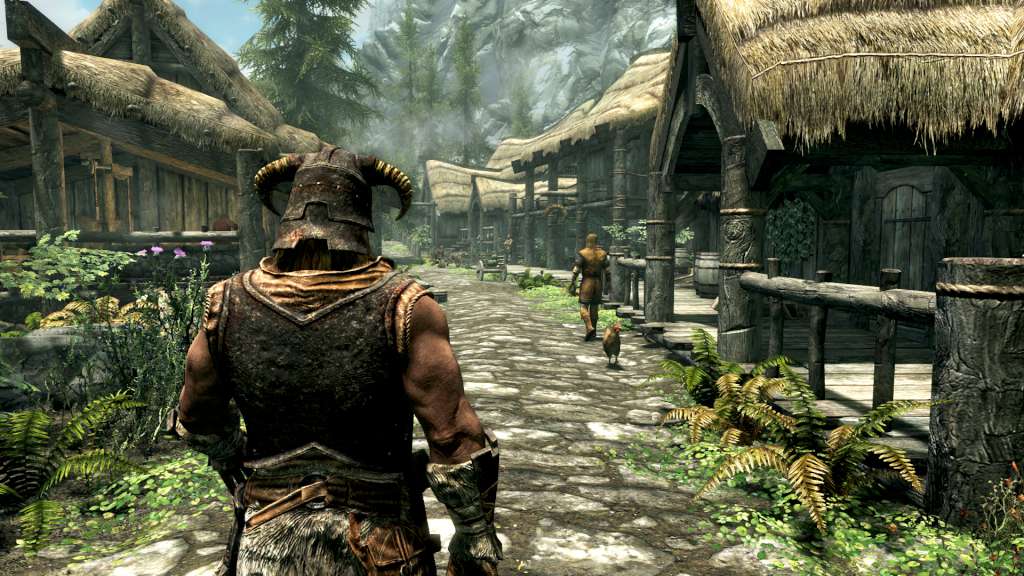
Image result for the elder scrolls skyrim
(One of the first town's you'll come across, Riverwood in Skyrim)

The game pits you against two factions of the realm of Skyrim, The Imperials and the Stormcloaks. Each has their own moral compass and ideologies that make them morally ambiguous with The Imperials allowing the disintegration of the Stormcloaks and the sovereignty of their lives but wish to restore peace as well as offer better rights for elves and minorities. The Stormcloaks wish to restore Skyrims culture and sovereignty away from a tyrannical empire but would restrict people back to traditions (like racism against elves and other races) irregardless of anything other than the idea of "preserving culture." It makes for a powerful and potent moral dilemma that makes it difficult but noteworthy.
Image result for skyrim skill tree]Image result for skyrim skill tree]
(The skills trees of Skyrim: More than what is featured!)

Another praiseworthy aspect is the RPG Tree of skills coming from a variety of means to level up and how it can be accomplished. Though the many ideas of certain classes are present, it instead allows free reign of allowing anyone to challenge themselves or better themselves with a roundabout warrior, mage, or thief as the general three classes. But you can really make it whatever you wish as you find special runestones to upgrade yourself and fight the many monsters and armies of Skyrim.

Also, the expansive terrain and the socio-political culture is rich thanks to careful and meticulous world building Bethseba has implemented in their design to make exploration the world both a treat and a rewarding experience for those who progress farther through the game and can chose to do the main storyline or not.